

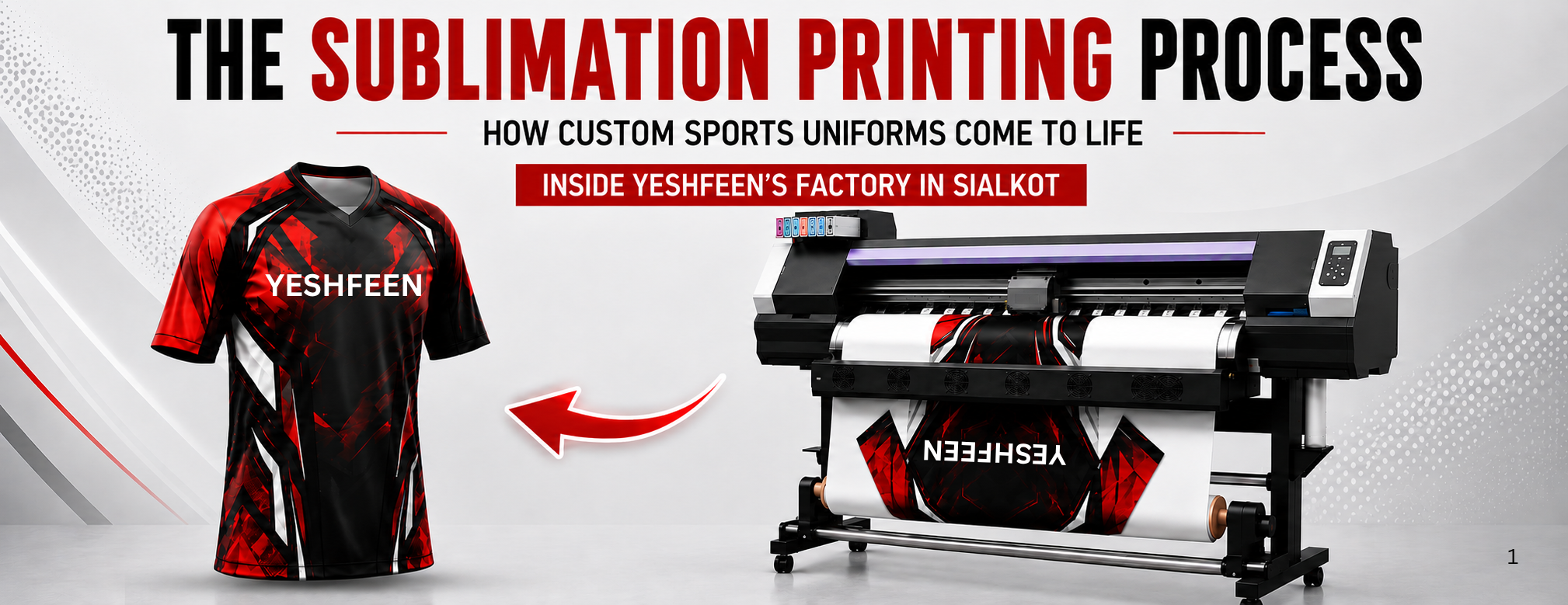
Sublimation printing is a process where dye is turned into a gas under heat and pressure, then permanently bonded into polyester fabric fibres — rather than sitting on top of the fabric like traditional printing. This is why sublimated sports uniforms don’t crack, peel, or fade with washing.
Most coaches and team buyers hear ‘sublimation’ from every manufacturer they contact, but few explain what it actually means or why it matters for a jersey that gets washed forty times in a season.
This guide explains the process in plain terms, compares it honestly against screen printing, and tells you exactly what to check before you approve an order.
How Sublimation Printing Actually Works
Sublimation is a three-stage process, and understanding each stage explains why the result is so durable:
- Design printing — the design is printed onto special transfer paper using sublimation ink, at a minimum resolution of 300 DPI to avoid pixelation at full jersey size
- Heat and pressure — the transfer paper is placed against the fabric and pressed at high temperature (typically 195-210°C) for a set number of seconds under firm, even pressure
- Gas transformation — under that heat, the solid dye converts directly into a gas without passing through a liquid state. The gas penetrates the polyester fibers and bonds at a molecular level as it cools
The result: the design becomes part of the fabric itself, not a layer sitting on the surface. This is the entire reason sublimated jerseys survive hundreds of wash cycles without cracking — there’s no surface layer to crack.
This is the same process described in our custom football kit design guide, which covers how sublimation fits into the full design and ordering process.
Why Sublimation Only Works on Polyester
This is the detail that surprises most first-time buyers: sublimation cannot print on cotton and doesn’t work well on dark-coloured fabric without extra steps.
| Fabric Type | Sublimation Result | Why |
| 100% white/light polyester | Excellent — full color range | Dye bonds directly with polyester’s chemical structure |
| Polyester blends (80%+) | Good — slightly muted colors | Enough polyester content for the dye to bond effectively |
| 100% cotton | Does not work | Cotton fibers have no chemical bond point for sublimation dye |
| Dark or black base fabric | Poor without treatment | Dye is transparent — dark fabric shows through the design |
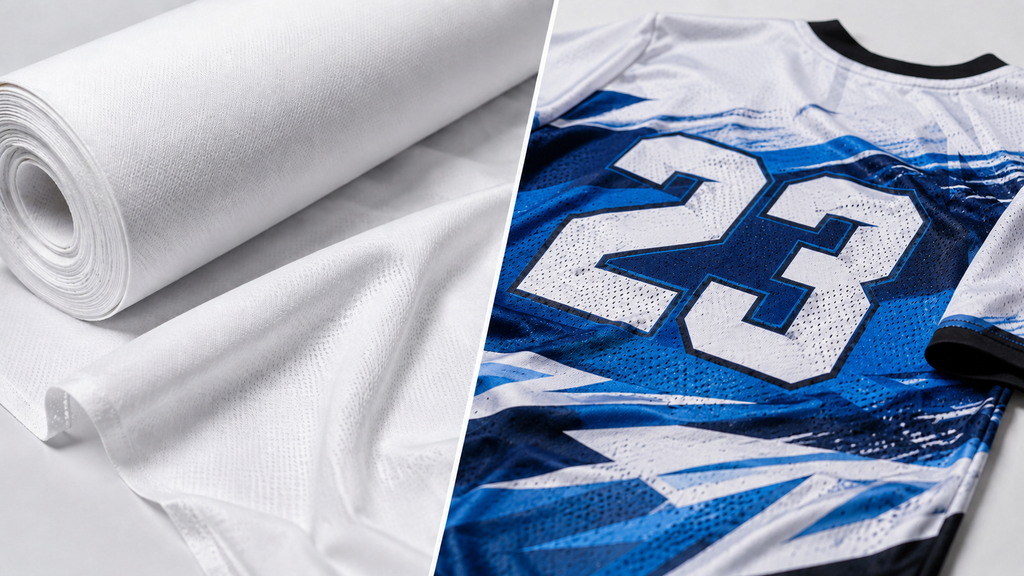
This is why every sublimated sports jersey starts as white or light-coloured polyester fabric — the sublimation process itself creates the colour, including the base colour of the jersey, not just the logo or numbers.
Sublimation vs. Screen Printing: The Honest Comparison
Both methods have a place — but for full-colour sports uniforms with numbers, names, and sponsor logos, they perform very differently over a season of wear.
| Factor | Sublimation | Screen Printing |
| Durability over time | Won’t crack or peel — becomes part of the fabric | Sits on top of fabric, will crack/peel eventually with washing |
| Color limit | Unlimited colors, gradients, and photorealistic designs | Each color is a separate print step; cost rises with color count |
| Weight added to fabric | None — fabric feels the same after printing | Adds a slight layer of ink texture and weight |
| Breathability | Fully breathable — no surface layer blocking airflow | Slightly reduced in heavily printed areas |
| Best for | Full-color jerseys, all-over designs, numbers and names | Simple 1-3 color logos on a small area, lower order volume |
| Fabric requirement | Polyester only, light-colored base | Works on cotton, polyester, most fabric types |
For a full team jersey with player numbers, sponsor logos, and multi-colour designs, sublimation is the standard across professional and competitive sportswear manufacturing for exactly these durability and colour reasons.
Yeshfeen uses full sublimation across every sport we manufacture for. Our client case study of a USA football team’s jersey order shows the finished result on a real 500-jersey order.
What Can Go Wrong — and How a Good Factory Prevents It
Sublimation is a precise process. When it’s done poorly, common problems include:
- Colour bleeding — happens when transfer paper shifts during pressing or when there’s residual moisture in the fabric before pressing. Prevented by pre-pressing fabric to remove moisture and taping the transfer paper securely
- Faded or dull colours — usually caused by insufficient heat, pressure, or press time. A properly calibrated heat press with verified temperature settings avoids this
- Uneven colour across a large design — caused by an uneven pressing surface. A quality factory uses a pressing pillow or platen designed for garment shape to keep pressure even across seams and curves
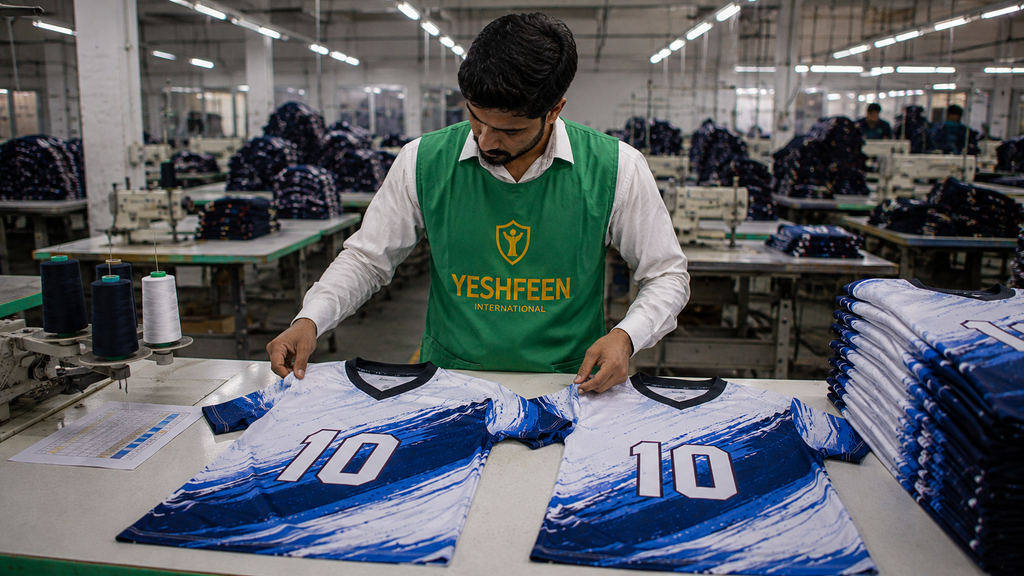
This is exactly why the physical sample step matters before any bulk order — a sample lets you check colour accuracy, sharpness, and evenness before 500 identical jerseys are produced with the same settings.
The sample approval step is a required stage in every Yeshfeen order — see it in context in our custom tracksuits wholesale buying guide, which walks through the full ordering process step by step.
What to Ask Your Manufacturer Before You Order
These questions separate a manufacturer who genuinely understands sublimation from one who just uses the word:
- What DPI do you print designs at? (300 DPI minimum is standard for sharp, non-pixelated results.)
- What fabric GSM do you use, and is it 100% or blended polyester?
- Do I get a physical sample before bulk production, or only a digital mockup?
- What’s your colourfastness rating? (Ask for an AATCC grade — Grade 4 or higher withstands regular competitive-season washing.)
- Can you match specific Pantone or hex colour codes, or only approximate colours?
If a manufacturer can’t answer these with specific numbers, they likely don’t have the quality control process a full sublimation run requires.
Yeshfeen International: Sublimation Manufacturing Since 1979
Yeshfeen has manufactured sublimated sports uniforms in Sialkot, Pakistan, since 1979 — 47 years of manufacturing experience — across every major sport, for teams and programmes across 45+ countries.
- Full sublimation printing at 300+ DPI for sharp, photo-quality results
- Performance polyester fabric tested for AATCC colorfastness before bulk production
- Physical sample produced and approved before any bulk order begins
- No minimum order quantity — the same sublimation quality process for 12 jerseys or 1,200
- Order capacity ranging from 50 to 10,000+ pieces
For teams building a full uniform programme beyond jerseys, our wholesale guide for universities and leagues covers coordinating sublimated uniforms across multiple sports and age divisions.
Frequently Asked Questions
Q: Does sublimation printing fade over time?
A: Properly done sublimation printing on quality polyester fabric maintains its colour for hundreds of wash cycles, often outlasting the garment itself, because the dye is bonded into the fibre rather than sitting on the surface. Fading is more commonly a sign of insufficient heat or pressure during the original printing, not a limitation of the process itself.
Q: Can sublimation printing be used on cotton jerseys?
A: No. Sublimation requires polyester fabric — the dye needs polyester’s chemical structure to bond with under heat. Cotton fibres don’t have the same bonding point, so sublimation simply won’t transfer onto 100% cotton fabric. This is why virtually all sublimated sports uniforms use performance polyester.
Q: Is sublimation better than screen printing for team jerseys?
A: For full-colour jerseys with player numbers, names, and multi-colour designs, yes — sublimation doesn’t crack or peel, adds no weight or texture to the fabric, and has no per-colour cost increase. Screen printing remains a reasonable choice for simple 1-2 colour logos on a small area of the garment.
Q: Why do sublimated jerseys need to start as white fabric?
A: The sublimation process creates all the colour on the garment, including the base colour — not just logos or numbers. Starting with white or light-coloured polyester lets the dye display true colours. A dark base fabric would show through the design, muddying the intended colours.
Q: How can I check sublimation quality before ordering in bulk?
A: Always request a physical sample before bulk production, not just a digital mockup. A sample lets you check colour accuracy against your approved Pantone or hex codes, sharpness of small details like numbers, and overall evenness — problems that are far cheaper to catch on one sample than on a full order.
About the Author
Ummar Farooq, Manufacturing Director, Yeshfeen International Sports Wear
Yeshfeen International has manufactured custom sports uniforms in Sialkot, Pakistan, since 1979 — 47 years of manufacturing experience — exporting to 45+ countries with a growing focus on USA teams, clubs, schools, and leagues. Ummar oversees production directly, including quality control on every sublimation run, from initial design brief through final delivery.
LinkedIn: linkedin.com/in/ummar-farooq-06718947 | Email: ummar@yeshfeen.com
| Start Your Custom Tracksuit Order Today Tell us your sport, colours, and quantities — we’ll send you a free design mockup within 48 hours. ✓ No minimum order ✓ Free mockup in 48 hours ✓ Physical sample before bulk 📩 ummar@yeshfeen.com | fahad@yeshfeen.com 📞 WhatsApp: +92 331 7770100 🌐 yeshfeen.com |