
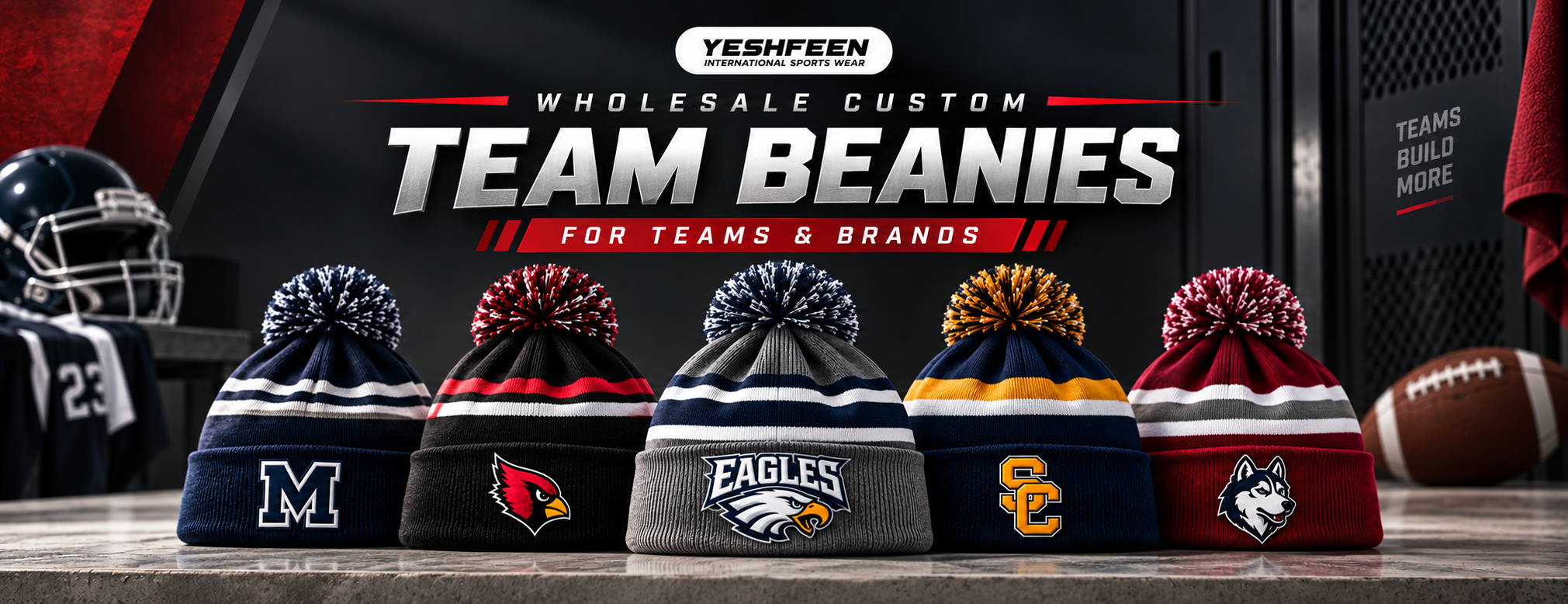
Custom beanies are knit winter hats produced with embroidered or woven-patch branding, ordered wholesale by sports teams, gyms, schools, and brands. Unlike jerseys, beanies cannot be sublimated — knit fabric doesn’t accept dye-sublimation printing — so branding is applied through embroidery, woven patches, or knit-in jacquard designs.
Beanies are usually treated as an afterthought in a uniform order, which is exactly why so many programmes end up disappointed with them. A jersey gets three conversations about fabric weight and print method. A beanie gets a colour and a logo file, and then someone is surprised when the embroidery puckers or the hat loses its shape after a season.
This guide covers what actually matters when buying custom beanies for a team, gym, school, or brand — knit construction, branding methods, fit styles, sizing, and budget planning.
Why Beanies Are Manufactured Differently Than Jerseys
The single most important thing to understand about custom beanies is that they are a knit product, not a cut-and-sew product. A jersey is made from a flat roll of fabric that is cut into panels and stitched together. A beanie is knitted as a tube or shaped piece on a knitting machine, which changes almost every decision downstream.
This matters for three practical reasons:
- Sublimation is not an option — dye-sublimation bonds ink to polyester fibres under heat, and it requires a smooth, flat, high-polyester surface. Knitted acrylic and wool blends have an open, textured structure that the process cannot hold. Any manufacturer offering a ‘sublimated beanie’ is either using a printed patch or is about to deliver something that looks nothing like the mockup
- Colour count is set at the knitting stage, not the printing stage — on a jersey, adding a fourth or fifth colour costs nothing extra because it all goes down in one print pass. On a knit beanie, each additional yarn colour is a separate cone loaded onto the machine, which affects both setup and price
- Shape retention depends on yarn quality, not construction — a beanie that goes baggy after three wears has nothing to do with stitching. It is the yarn. Cheap acrylic with low elastic recovery stretches out and stays stretched, which is the most common complaint programmes have about bulk beanie orders
Programmes that carry their jersey-buying instincts straight into a beanie order tend to focus on the wrong variables. With jerseys you ask about GSM and the print method. With custom beanies, you ask about yarn composition, gauge, and branding method.
Knit Types and Yarn Composition — What to Actually Ask For
Beanie quality comes down to two specifications that most buyers never ask about: what the yarn is made of, and how tightly it is knitted.
| Yarn/Blend | Characteristics | Best Suited To |
| 100% acrylic | Cost-effective, holds dye colour brightly, and has good shape retention when the grade is decent. | Team merchandise, fan giveaways, large-volume orders |
| Acrylic-wool blend | Softer hand feel, better insulation, slightly more premium appearance | School and university programmes, corporate gifting |
| 100% merino wool | Softest and warmest, naturally odour-resistant, highest cost | Premium retail lines, executive gifting |
| Acrylic with fleece lining | Standard knit exterior with a brushed fleece band or full lining inside | Cold-climate outdoor programmes, winter sports staff |
| Recycled polyester blend | Comparable performance to acrylic with a sustainability claim | Brands with stated environmental commitments |
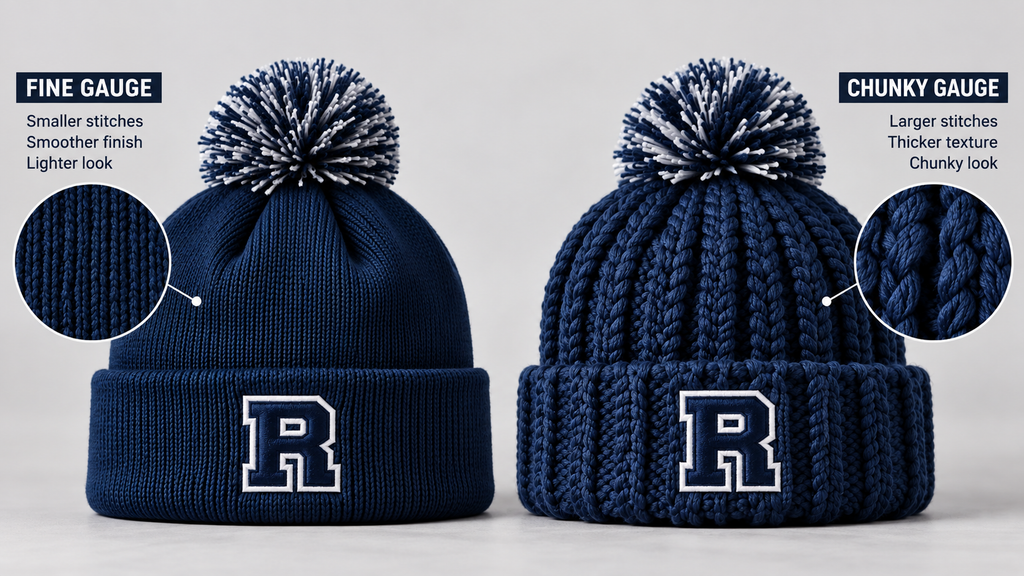
Gauge is the second specification, and it describes how tight the knit is. A fine-gauge beanie has a smooth, dense surface and holds embroidered detail cleanly. A chunky-gauge beanie has visible, chunky stitches and a more casual, streetwear look — but fine embroidered detail gets lost in the texture.
- Fine gauge — smooth surface, best choice when your logo has small text, thin lines, or fine detail that needs to stay legible
- Medium gauge — the most common specification for team and corporate orders, balanced between structure and comfort
- Chunky or cable gauge — heavier, more textured, suits simple bold marks and woven patches rather than detailed embroidery
Ask your manufacturer directly: ‘What is the yarn composition, and what gauge is the knit?’ A generic answer of ‘premium knit’ without a composition or gauge specification usually means the same stock blank is being supplied across every order, with only the logo changing.
This is the same principle that applies to jersey fabric, where the specification question separates a manufacturer from a reseller.
For a deeper look at how fabric specification works across the rest of a uniform order, our wholesale guide for universities and leagues covers how to standardise specifications across an entire program.
Branding Methods — Embroidery, Patches, and Knit-In Designs
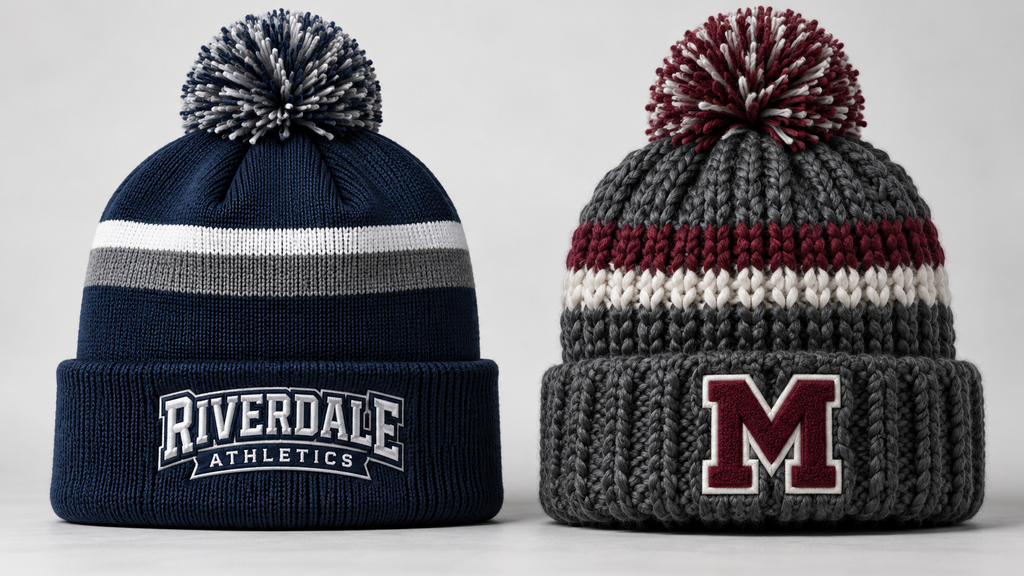
Because sublimation is off the table, custom beanies use three branding methods. Each has a different cost structure and a different practical limit, and choosing the wrong one for your logo is the most common reason a beanie order looks wrong on arrival.
Direct Embroidery
Direct embroidery stitches your design straight into the knit, usually on the front panel or the folded cuff. It is the standard method for custom beanies and the most durable — the stitching becomes part of the hat and survives repeated washing far better than anything applied to the surface.
- Works best with simple, bold marks — a team monogram, a wordmark, or a crest with clear separation between elements
- Small text is the limitation — anything below roughly a quarter inch in height tends to lose definition, because the knit stretches slightly under the needle and the stitches settle into the texture
- Stitch count drives cost — a dense, multi-colour embroidered crest carries more cost than a single-colour wordmark, since cost scales with the number of stitches rather than the size of the design
- Placement options include the front panel, the cuff face, the side, and the back — cuff placement is the most common for team orders
Woven or Leather Patches
A patch is produced separately and then stitched onto the beanie. This is the right method when direct embroidery cannot carry your design — typically when the logo has fine detail, gradients, many colours, or small legible text.
- Handles detail and colour that embroidery cannot — a full-colour crest with fine linework reproduces cleanly on a woven patch
- Gives a more premium, retail-brand appearance, particularly leather and faux-leather patches on chunky-gauge beanies
- Adds a component to the production process — the patch is manufactured, then applied, which is worth knowing when planning your order timeline
Knit-In Jacquard Designs
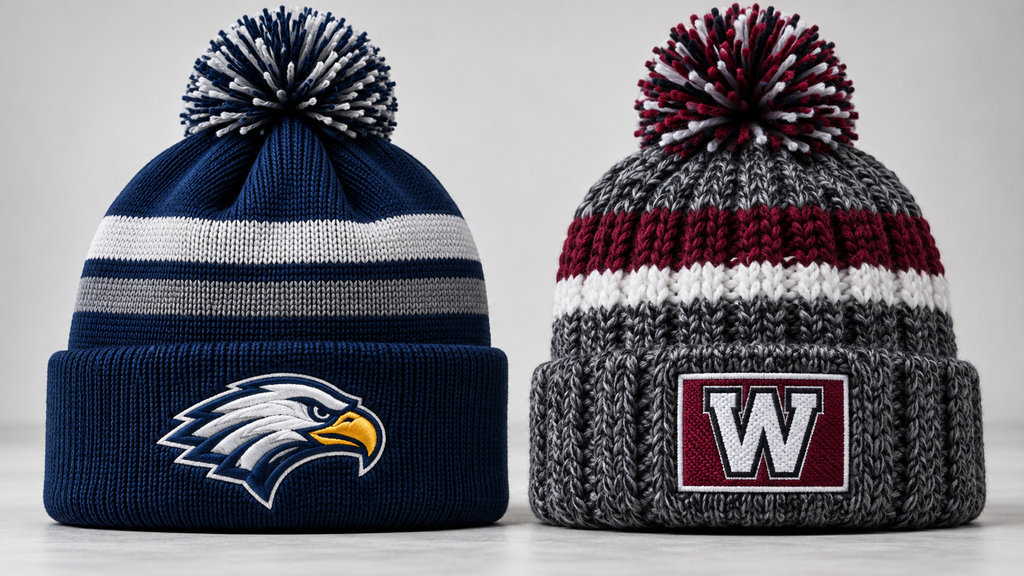
Jacquard knitting works the design into the hat itself using different coloured yarns, rather than applying anything on top. Stripes, chevrons, repeating patterns, and simple geometric marks all work this way.
- The design is structurally part of the hat — there is nothing to peel, crack, or come loose, ever
- Limited to relatively simple, geometric designs — a detailed crest cannot be knitted in with acceptable definition
- Each yarn colour is a separate setup on the machine, so colour count affects cost more than it would with embroidery
A practical approach many programmes use: knit-in stripes in team colours for the body of the hat, with an embroidered mark or small patch on the cuff. The result reads as a designed product rather than a blank hat with a logo on it.
If you are comparing branding methods across your whole uniform order and want to understand why jerseys and beanies are decorated so differently, our sublimation printing guide explains what sublimation does and where its limits are.
Fit Styles — Cuffed, Slouch, and Pom
Fit style is a real decision with custom beanies, in the same way sleeve length is a real decision on a volleyball jersey. It affects both who will actually wear the hat and how much branding surface you have to work with.
- Cuffed — a folded band around the lower edge, the standard for team and corporate orders. The double-layer cuff gives a clean, flat surface for embroidery and holds its shape well
- Slouch or uncuffed — longer body, worn loose at the back, popular with younger wearers and lifestyle or fan merchandise lines. Branding usually sits higher on the front panel since there is no cuff
- Pom-pom — a cuffed beanie with a yarn or faux-fur pom on top. Common for fan merchandise, winter event giveaways, and youth programmes
- Fisherman or short cuff — a shorter, tighter fit that sits above the ears, a more current streetwear silhouette with a limited branding area
For team orders where every player receives the same item, cuffed is the safe default — it suits the widest range of head sizes and preferences. For merchandise you intend to sell rather than distribute, offering two styles across the same design usually sells better than a single style in more colours.
Sizing — Why Beanies Are Simpler, With One Exception
Beanie sizing is far simpler than jersey sizing, which is a genuine advantage when ordering for a large group. Most adult beanies are produced one-size-fits-most, because the knit stretches to accommodate a wide range of head circumferences.
- Adult one-size covers the large majority of a roster or staff group — no need to collect individual measurements the way you would for jerseys
- Youth sizing is the exception and does need separate attention — a youth beanie is knitted to a smaller circumference, not simply an adult hat that stretches less. Ordering an adult one-size for a youth programme results in hats that slip over the eyes
- Fine-gauge knits have less stretch than chunky knits, so if your order is fine-gauge for embroidery reasons, confirm the circumference range with your manufacturer rather than assuming one size will cover everyone
For youth programmes ordering beanies alongside uniforms, our custom youth sports uniforms buying guide covers the youth sizing considerations that apply across every item in a youth order, including accessories.
Budget Planning — Where Beanies Fit in an Order
Beanies are one of the lowest cost-per-unit items in custom team apparel, which makes them useful in situations where a jersey order would not be viable.
- Cost per unit is low enough for full-group distribution — outfitting an entire roster, coaching staff, and support team is realistic in a way that jackets or full uniforms usually are not
- Volume moves the price meaningfully — the setup work for embroidery or a knitting run is largely fixed, so per-unit cost drops noticeably as quantity increases. Programs ordering for a full season plus spares see better pricing than those placing a small trial order
- Bundling with a uniform order reduces the effective shipping cost per piece, since accessories add relatively little volume and weight to a shipment already going out
- Reorders are common — beanies get lost more than jerseys do, and merchandise lines sell unevenly. Confirm your manufacturer will handle small fill-in runs without a long delay
One clarification worth stating plainly, because it is a common source of confusion: Yeshfeen has no minimum order on sublimated garments, but beanies are not a sublimated product. Knit accessory orders carry a minimum of 25 pieces per design. If you have read elsewhere on this site that there is no minimum, that applies to sublimated jerseys and kits, not to knitwear.
For programmes that are budgeting a full winter package — beanies, hoodies, and warm-up layers together — pricing the whole set at once rather than item by item usually produces a better total than three separate orders placed weeks apart.
Seasonal Timing — When to Place a Beanie Order
Beanies are bought in a narrower window than most team apparel, and the programmes that get them wrong are almost always the ones that are ordered late.
- Winter sports programmes need them before the season opens, which in practice means the order should be placed in late summer or early autumn rather than once the weather turns
- Fan and retail merchandise lines need stock on hand before the first cold-weather home fixture, since that is when walk-up merchandise sales spike
- Corporate gifting orders concentrate heavily in the final quarter of the year, which is also when manufacturing capacity across the industry is most constrained
- End-of-season and off-season orders are the quiet opportunity — programmes that order in spring for the following winter get the same product without competing for autumn capacity
Because beanies sit on the same production floor as everything else, ordering them together with a uniform package rather than as a separate late addition is both simpler and less exposed to seasonal capacity pressure.
Yeshfeen International: Custom Beanies for USA Teams and Brands
Yeshfeen has manufactured custom sports apparel and accessories in Sialkot, Pakistan, since 1979 — 47 years of manufacturing experience — exporting to 45+ countries, with in-house embroidery capability for accessory branding.
- Acrylic, acrylic-wool blend, merino, fleece-lined, and recycled polyester blend yarn options
- In-house Tajima embroidery machines — accessory branding is produced on our own floor, not subcontracted out
- Direct embroidery, woven and leather patch, and knit-in jacquard branding are all available
- Cuffed, slouch, pom-pom, and short-cuff fit styles, in adult and youth sizing
- 25-piece minimum per design on knit accessories
- Free digital design mockup within 48 hours; physical sample approved before bulk production begins
- Sedex approved, Accord listed, WRAP certified, plus ISO certification
If your programme is ordering beanies as part of a wider winter package, our custom tracksuits wholesale guide covers warm-up and outer layer ordering for teams.
Frequently Asked Questions
Q: Can custom beanies be sublimated like jerseys?
A: No. Dye-sublimation requires a smooth, flat, high-polyester surface, and knit acrylic or wool has an open textured structure the process cannot hold. Custom beanies are branded through direct embroidery, woven or leather patches, or knit-in jacquard designs instead.
Q: What is the minimum order for custom beanies?
A: 25 pieces per design. Note that while Yeshfeen has no minimum on sublimated garments, beanies are a knit product rather than a sublimated one, so the 25-piece minimum applies to accessory orders.
Q: Which branding method is best for a detailed logo?
A: A woven patch. Direct embroidery struggles with fine linework and text below roughly a quarter inch in height, because the knit stretches slightly under the needle and small detail settles into the texture. A woven patch reproduces fine detail, gradients, and multiple colours cleanly.
Q: Why do some beanies lose their shape after a few wears?
A: Yarn quality, not construction. Low-grade acrylic has poor elastic recovery, so once it stretches, it stays stretched. Asking for the yarn composition and gauge specification before ordering is the way to avoid this.
Q: Do you offer youth sizing for custom beanies?
A: Yes. Youth beanies are knitted to a smaller circumference rather than being adult hats that stretch less, which matters because an adult one-size beanie on a youth programme will slip down over the eyes.
Q: Can you match our exact team colours?
A: Yes. We work from Pantone references or an existing uniform colourway to match yarn and embroidery thread as closely as the knitting process allows. Yarn colour matching has slightly different tolerances than fabric dyeing, which we confirm at the sample stage before bulk production.
About the Author
Ummar Farooq, Manufacturing Director, Yeshfeen International Sports Wear
Yeshfeen International has manufactured custom sports uniforms and accessories in Sialkot, Pakistan, since 1979 — 47 years of manufacturing experience — exporting to 45+ countries. Ummar oversees production and client relationships directly, working with coaches, athletic directors, gym owners, and brand managers from initial brief through final delivery.
LinkedIn: linkedin.com/in/ummar-farooq-06718947 | Email: ummar@yeshfeen.com
| Ready to Order Custom Beanies for Your Team or Brand? Tell us your quantity, colours, branding preference, and when you need them — we’ll send a free proposal within 48 hours. 25-piece minimum | Free mockup in 48 hours | Direct USA shipping Email: ummar@yeshfeen.com | fahad@yeshfeen.com WhatsApp: +92 331 7770100 | yeshfeen.com |