

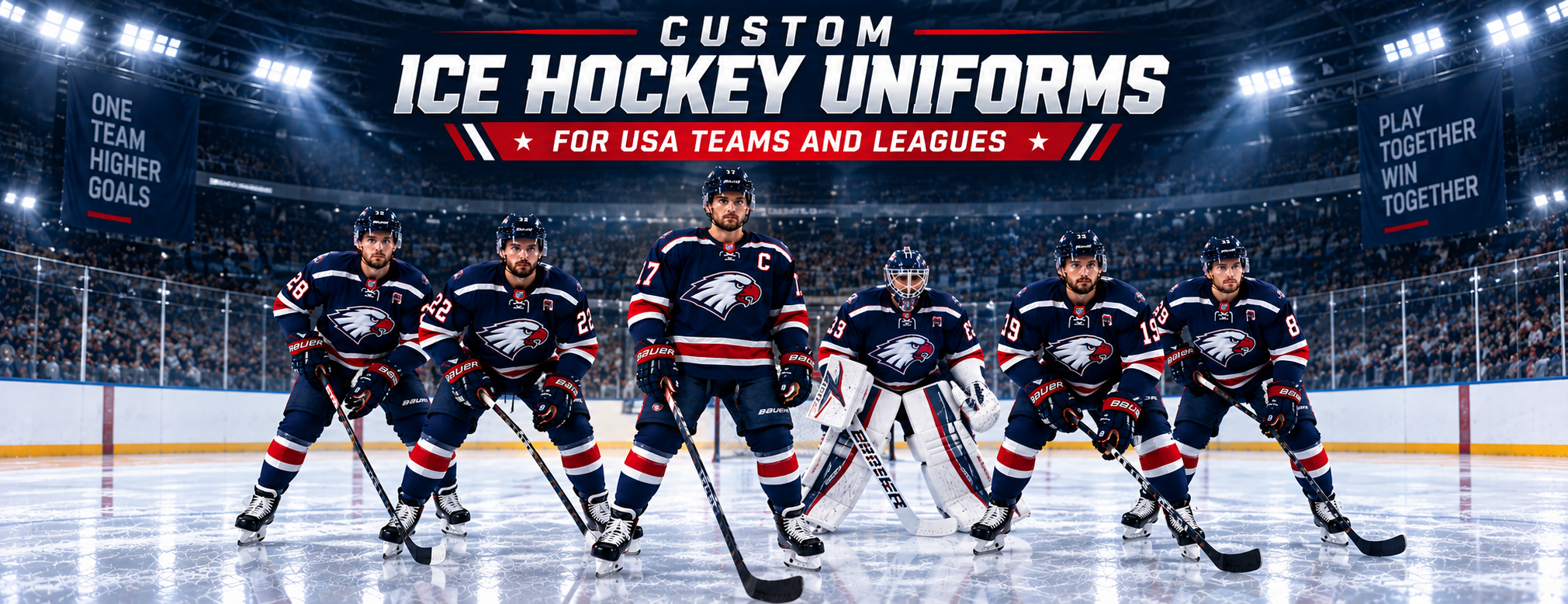
Custom ice hockey uniforms are team kits built around a sublimated jersey cut oversized to fit over shoulder and chest pads, paired with matching socks and often a separate goalie cut. Hockey jerseys carry construction requirements no other sport has — reinforced shoulder and elbow zones, a durable neck binding, and in many leagues a fight strap.
Hockey is the most demanding sport in team apparel manufacturing, and it is the one where cheap uniforms fail fastest. A basketball jersey lives a fairly easy life. A hockey jersey gets pulled, grabbed, dragged across boards, soaked through every session, and washed more often than any other kit in the sport.
It is also the sport where buyers most often order the wrong size, because a hockey jersey is not sized to the player — it is sized to the player wearing full equipment. This guide covers what actually matters when buying custom ice hockey uniforms for a club, high school, junior, or adult league programme.
Why Hockey Jerseys Are Built Differently Than Every Other Sport
Three things separate a hockey jersey from every other jersey a manufacturer produces, and all three are construction decisions rather than design decisions.
- The fit is built around equipment, not the body — a hockey jersey is cut deliberately oversized, with a wide shoulder yoke and a generous chest, because it has to sit over shoulder pads and a chest protector without pulling. A jersey that fits the player’s measurements will not fit the player
- Specific zones take specific abuse — the shoulders, elbows, and underarms absorb contact against boards and other players. These are the areas that fail first on a poorly constructed jersey, which is why reinforcement in those zones matters more than overall fabric weight
- Wash frequency is far higher than any other sport — hockey players sweat through equipment every session, and jerseys are washed constantly through a long season. This is where screen-printed graphics and heat-applied vinyl give out, usually within the first season
The practical consequence is that fabric weight alone tells you very little about a hockey jersey. A heavy fabric with weak seams and applied graphics will fail before a lighter fabric with reinforced construction and sublimated print. Both cost roughly the same to buy.
Fabric and Construction — What to Actually Ask For
Hockey jersey fabric decisions come down to weight, knit structure, and where reinforcement is placed.
| Component | Typical Fabric | Why |
| Adult game jersey | 140-150 GSM polyester air knit | Open-structure knit that breathes through heavy exertion under full equipment, with enough body to hold an oversized cut |
| Youth game jersey | 130-140 GSM polyester air knit | Lighter weight suited to smaller frames, since a heavy jersey over youth pads restricts movement |
| Practice jersey | 140-150 GSM polyester, simplified construction | Same fabric, fewer reinforcement zones and simpler graphics, since practice kit takes less contact and is replaced more often |
| Goalie jersey | Same weight, substantially wider cut | Must clear chest and arm protector, which is significantly bulkier than a skater’s equipment |
| Socks | Knit polyester, ribbed | Worn over shin guards, needs stretch and length to stay up through a shift |
Air knit is the specification worth knowing. It is a polyester knit with a deliberately open structure that lets heat and moisture escape, which matters enormously under a full set of pads. A tightly woven fabric of the same weight traps heat and becomes heavy with sweat through a game.
On reinforcement, ask specifically where it is placed rather than whether it exists:
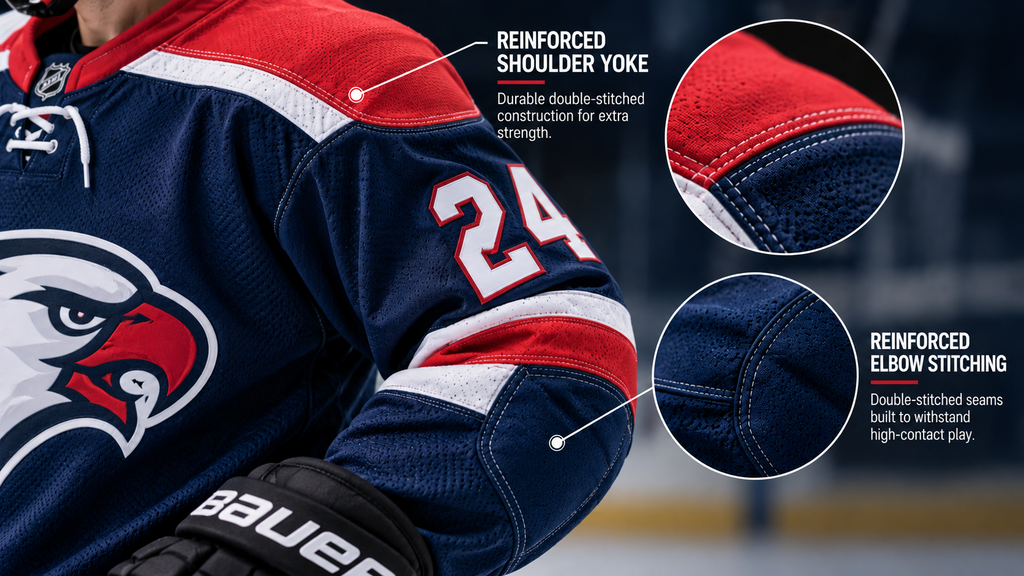
- Shoulder yoke — should be a separate reinforced panel, not a continuation of the body fabric
- Elbows and underarms — the highest-stress seams in the garment and the most common failure point
- Neck binding — a hockey collar gets grabbed and pulled. A single-stitch binding tears out; a double-stitched or bound collar holds
- Hem and side vents — take stress from the oversized cut moving over equipment
Ask your manufacturer directly: ‘What GSM is your hockey jersey fabric, is it air knit, and which zones are reinforced?’ A generic answer of ‘heavy duty polyester’ without a GSM figure or named reinforcement zones usually means the same base jersey is being supplied across multiple sports with a hockey cut applied.
For programs standardising fabric specifications across several sports at once, our wholesale guide for universities and leagues covers how to set one specification standard across an entire athletic department.
Why Sublimation Is the Standard for Hockey
Almost every custom hockey jersey produced today is fully sublimated, and the reason is specific to hockey’s wash cycle and contact load rather than a general preference.
What sublimation does
Sublimation turns ink into gas under heat and bonds it directly into the polyester fibre. The design becomes part of the fabric. There is no layer sitting on the surface, which means there is nothing that can crack, peel, or lift at the edges.
Why the alternatives fail in hockey specifically
- Heat-applied vinyl and twill numbers sit on top of the fabric and are held by adhesive or edge stitching. Under repeated contact and high-frequency washing, the edges lift first, then the whole element peels
- Screen printing cracks along fold lines, and a hockey jersey folds constantly at the shoulders and elbows through a full range of motion
- Both methods add weight and a layer of insulation exactly where a player is already carrying pads, which is the opposite of what the garment needs to do
Where traditional methods still make sense
Twill crests and stitched lettering remain genuinely popular in hockey, more than in any other sport, for heritage and league-affiliated programmes where the traditional look is the point. This is a legitimate choice, not a compromise — but it should be a deliberate one, with the understanding that a stitched twill crest needs more care through a season than a sublimated one.
Many programs run a hybrid: sublimated body, colours, and numbers, with a stitched twill crest on the chest. This gives the traditional appearance where it is visible and the durability of sublimation everywhere that takes abuse.
For a full explanation of how sublimation works and how it compares to screen printing and embroidery across different garment types, see our sublimation printing guide.
League Rules Every Hockey Program Should Confirm
Hockey carries uniform requirements that do not exist in most other team sports, and they are enforced by officials rather than being style preferences. These need to be settled at the design stage, not discovered at the first game.
Fight straps
A fight strap, sometimes called a tie-down, is a short strap sewn inside the back hem of the jersey that fastens to the player’s pants. It prevents the jersey from being pulled off over the head. Many leagues — particularly junior, high school, and adult competitive levels — require it, while others do not, and some youth levels prohibit it.
- It must be sewn in at the manufacturing stage — retrofitting one into a finished jersey is possible but never as clean or as strong
- Confirm the requirement with your specific league before the design is finalised, since it varies by level and by governing body
- If your program spans multiple age divisions with different rules, specify per division rather than ordering one configuration for everyone
Captaincy lettering
The C and A worn by the captain and alternate captains are usually required to be a specified size and placed on the upper chest. Plan these as part of the design from the start. Programmes that add them later with heat-applied letters end up with the one element on the jersey that peels.
Number size and placement
Most leagues specify minimum number heights for the back and sleeves and require numbers to contrast clearly with the jersey. A dark number on a dark jersey fails inspection regardless of how good it looks in the mockup. Confirm the minimum heights your league sets before approving a design.
Name bars
Some programmes order a removable name bar that attaches above the back number rather than a sublimated name. This allows a jersey to be reassigned when a roster changes, which is worth considering for programmes that reissue kits between seasons rather than letting players keep it.
Because these requirements shift between leagues and are updated periodically, confirm all four with your league or governing body before finalising the design rather than relying on what a previous season’s kit did.
Goalie Uniforms — A Separate Order, Not a Larger Size
The most common ordering mistake in hockey is treating the goalie jersey as a bigger version of the skater jersey. It is a different garment.
- The cut is substantially wider through the chest and arms, because goalie chest and arm protectors are far bulkier than a skater’s shoulder pads
- Arm length and armhole shape differ, since a goalie’s range of motion is lateral and overhead rather than forward-driving
- Ordering an XXXL skater jersey for a goalie produces a garment that is too long in the body and still too tight across the arm protector
Specify the goalie cut as its own item in the order from the start, matching the fabric and design of the rest of the team but built to the goalie pattern. For a programme with two goalies, that is two pieces on a separate line — not two extra-large skater jerseys.
Sizing — The Part Most Programs Get Wrong
Hockey sizing is the single biggest source of reorders, and the cause is almost always the same: someone measured the players instead of measuring the players in their equipment.
- Size over full equipment, always — take chest measurements with shoulder pads and chest protector on. A player who wears a medium shirt may need a large or extra-large jersey
- Youth sizing needs separate attention — youth hockey jerseys are cut to youth proportions over youth pads, not adult jerseys scaled down. Youth equipment is proportionally bulkier relative to frame size than adult equipment
- Growing players mid-season is a real planning factor in youth hockey — many programmes deliberately size up one step for the youngest divisions, accepting a looser fit early in the season
- Order spares in the most common sizes — hockey loses and damages more jerseys than any other sport, and a mid-season reorder of one piece takes as long to produce as a batch
For youth hockey programmes specifically, our custom youth sports uniforms buying guide covers the youth sizing considerations that apply across all youth sports, including sizing over protective equipment.
Budget Planning for Hockey Programmes
Hockey carries the highest kit cost per player of any team sport, because a full programme means more pieces than a single jersey.
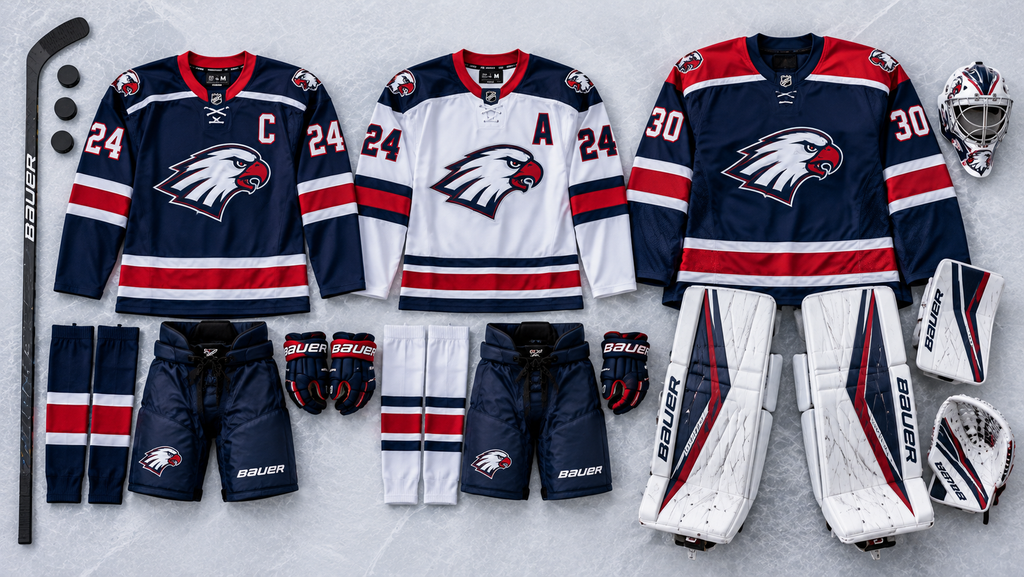
- Price the full kit, not the jersey — most programmes need a home set, an away set, socks to match both, and practice jerseys. A per-player budget built on the jersey price alone will be badly short
- Two sets is the norm, not an upgrade — leagues generally require contrasting home and away jerseys, so this is a baseline requirement rather than an optional extra
- Practice jerseys can be specified down — same fabric, simpler construction and graphics, which brings the cost of the highest-turnover item down without affecting game kit quality
- Goalie pieces are separate line items and should be budgeted as such, not absorbed into the skater count
- Reorder budget is not optional in hockey — build a contingency for mid-season replacements into the initial budget rather than treating each one as an unplanned expense
The 25-piece minimum per design works out well for hockey because a home set and an away set are two separate designs. A roster of 18-plus spares clears the minimum comfortably on each. Programmes running multiple age divisions can often consolidate a shared design across divisions with different numbering, which reduces the number of separate design runs.
Seasonal Timing — When to Place a Hockey Order
Hockey has one of the longest lead requirements in team apparel, because the order involves more decisions than most and those decisions take time to settle.
- North American season openers concentrate in autumn, which means design work should begin in the preceding months rather than the weeks before
- The design approval stage takes longer in hockey than other sports — league rule confirmation, fight strap specification, captaincy lettering, number heights, and the goalie cut all need sign-off before production starts
- Tournament teams often need kit outside the main season, and the quieter production window can work in their favour
- Multi-division programs should place one consolidated order rather than staggered division-by-division orders, which keeps colour matching consistent across the whole club
The practical advice: start the conversation with your manufacturer before the design is finalised, not after. Most of the hockey-specific decisions in this guide are easier to settle in a mockup than in a change request once production has begun.
Yeshfeen International: Ice Hockey Uniforms for USA Teams
Yeshfeen has manufactured custom sports uniforms in Sialkot, Pakistan since 1979 — 47 years of manufacturing experience — exporting to 45+ countries, with construction specifications built for hockey’s contact and wash load.
- 140-150 GSM polyester air knit for adult jerseys, 130-140 GSM for youth
- Reinforced shoulder yoke, elbow, underarm, and neck binding construction
- Fight straps sewn in at the manufacturing stage where your league requires them
- Goalie cuts produced as a separate matched pattern, not an oversized skater jersey
- Full sublimation, stitched twill crests, or a hybrid of both
- Home and away sets, matching socks, and specified-down practice jerseys
- 25-piece minimum per design, with no minimum on sublimated garments
- Free digital design mockup within 48 hours; physical sample approved before bulk production begins
- Sedex approved, Accord listed, WRAP certified, plus ISO certification
If your programme orders warm-up and travel layers alongside the game kit, our custom tracksuit wholesale guide covers warm-up set ordering for teams.
For cold-weather accessories to complete a winter programme — team beanies for players, staff, and supporters — see our custom beanies wholesale buying guide.
Frequently Asked Questions
Q: What fabric weight is best for custom ice hockey uniforms?
A: Adult hockey jerseys typically use 140-150 GSM polyester air knit, with youth jerseys at 130-140 GSM. Air knit matters specifically in hockey because its open structure lets heat and moisture escape from under a full set of pads, whereas a tightly woven fabric of the same weight would trap both.
Q: What is a fight strap, and does my team need one?
A: A fight strap, or tie-down, is a short strap sewn inside the back hem that fastens to the player’s pants so the jersey cannot be pulled off over the head. Many junior, high school, and adult competitive leagues require it, some youth levels prohibit it, and others leave it optional. It must be sewn in during manufacturing, so confirm your league’s requirement before the design is finalised.
Q: Can I just order a larger skater jersey for my goalie?
A: No. A goalie jersey is a different pattern, cut substantially wider through the chest and arms to clear goalie chest and arm protectors. An oversized skater jersey ends up too long on the body while still being too tight across the arm protector. Specify the goalie cut as its own item in the order.
Q: How should I measure players for hockey jersey sizing?
A: Measure the chest with full equipment on — shoulder pads and chest protector included. Hockey jerseys are sized to the player in equipment, not to the player. A player who wears a medium shirt will often need a large or extra-large jersey.
Q: Why is sublimation preferred over stitched twill for hockey jerseys?
A: Hockey jerseys are washed more frequently and take more contact than any other team kit. Sublimated designs are bonded into the fabric fibre so there is nothing to crack, peel, or lift. Stitched twill crests remain popular for heritage and league-affiliated programmes, and a hybrid of a sublimated body with a twill chest crest is a common compromise.
Q: How many jersey sets does a hockey team need?
A: Two as a baseline — leagues generally require contrasting home and away jerseys. Most programmes also order practice jerseys, which can be specified with simpler construction and graphics in the same fabric to reduce the cost of the highest-turnover item.
About the Author
Ummar Farooq, Manufacturing Director, Yeshfeen International Sports Wear
Yeshfeen International has manufactured custom sports uniforms in Sialkot, Pakistan, since 1979 — 47 years of manufacturing experience — exporting to 45+ countries. Ummar oversees production and client relationships directly, working with hockey club directors, high school and junior coaches, and league administrators from initial brief through final delivery.
LinkedIn: linkedin.com/in/ummar-farooq-06718947 | Email: ummar@yeshfeen.com
| Ready to Order Custom Ice Hockey Uniforms for Your Program? Tell us your divisions, roster sizes, league rules, and season dates — we’ll send a free proposal within 48 hours. 25-piece minimum per design | Free mockup in 48 hours | Direct USA shipping Email: ummar@yeshfeen.com | fahad@yeshfeen.com WhatsApp: +92 331 7770100 | yeshfeen.com |